Your fitness tracker's recovery score is a single number built from several noisy inputs — heart rate variability (HRV), resting heart rate, sleep duration and sleep stages, sometimes respiratory rate and skin temperature — combined using weights the brand never publishes. It's a decent trend tool. It's a poor referee for a single day's training decision.
If you train four or more days a week, the practical implication is straightforward: treat the score as one data point in a decision your body should help make, not as a verdict that overrides how you feel. Below is what actually goes into these scores, why day-to-day readings wobble so much, and a subjective-first framework you can run in about 15 minutes.
Quick Takeaways
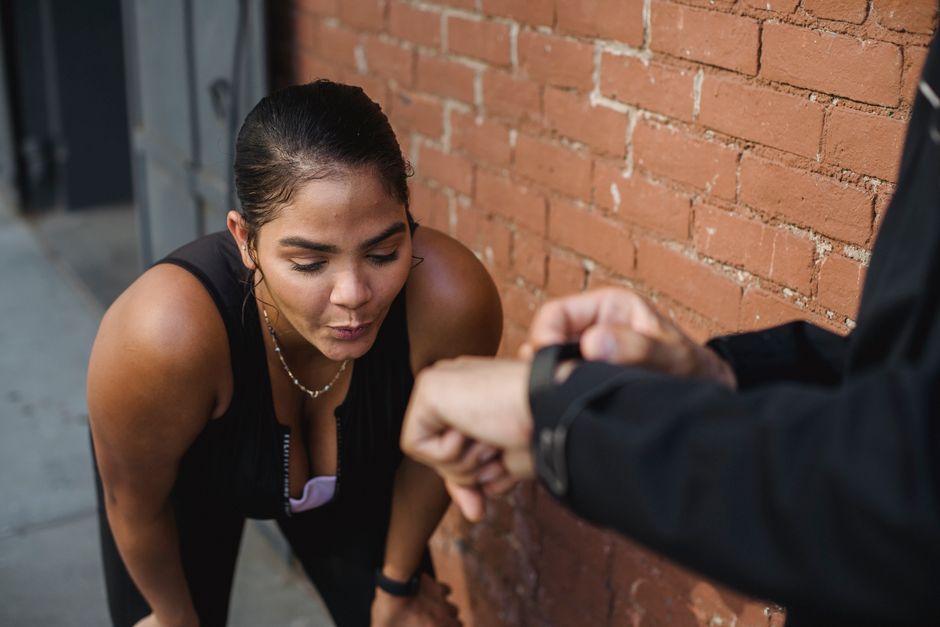
- Recovery scores blend HRV, resting heart rate, and sleep data using proprietary weights that differ by brand and can change with firmware updates.
- Day-to-day HRV is noisy. Alcohol, hydration, caffeine, stress, room temperature, and measurement timing can move it more than training does.
- Consumer sleep trackers estimate total sleep time reasonably well but misclassify sleep stages compared with lab polysomnography — and stages are a scoring input.
- Use a 7-day trend, a 30-second subjective check, and a 10-minute warm-up test before you cancel a session.
- Trust the score only after consistent wear with fixed wake times, and only when it agrees with how you feel.
What a Recovery Score Actually Combines
Most recovery scores draw from the same short list of signals. The difference is how each brand weights them, and that weighting is the part you never get to see.
Heart rate variability: the noisiest input
HRV measures the variation in time between heartbeats. Broadly, higher values suggest more parasympathetic ("rest and digest") activity, while lower values suggest more sympathetic drive or physiological strain. Devices rarely agree on which metric to use — some report rMSSD, others SDNN — and they sample over different windows at different times of day. Two watches can produce two different HRV numbers from the same night. That's why comparing your HRV to a friend's, or to a different brand's baseline, is close to meaningless.
More importantly, HRV is a moving target. It responds to training, but also to alcohol, dehydration, caffeine, room temperature, illness, psychological stress, and whether you woke naturally or to an alarm. Research on athletes has repeatedly shown that day-to-day HRV values swing substantially without any meaningful change in fitness or fatigue. The signal is real, but it lives in the trend, not the single reading. For a deeper look at how HRV behaves over time, see our guide to building an HRV baseline that means something.
Resting heart rate
Resting heart rate is more stable than HRV and easier to interpret. An elevated morning RHR — roughly five to seven beats above your normal baseline — is a reasonably reliable flag for incomplete recovery, dehydration, heat stress, alcohol, or an oncoming illness. On its own, though, a few beats of drift is normal noise, especially after a warm night or a late meal.
Sleep duration and stages
Total sleep time is usually the heaviest sleep input in a recovery score, and it's also the measure trackers estimate best. Stage breakdowns — light, deep, and REM — are where accuracy falls apart. If deep sleep accounts for a meaningful slice of your score and deep sleep detection is unreliable, then a chunk of that score rests on a shaky measurement.
The proprietary weighting problem
Brands weight these inputs differently, and the formulas are trade secrets. Some emphasize HRV and sleep performance. Others lean on accumulated activity load and stress-style metrics. Others blend in respiratory rate and skin temperature. Firmware updates can shift the algorithm, which means your baseline can move without your physiology moving at all. That isn't a conspiracy — it's product iteration — but it does mean the number is not a physiological constant you can track the way you track bodyweight or resting pulse.
Why a Single Night's HRV Reading Is a Weak Decision Input
Because the inputs are noisy, the output is noisy. A score that swings 30 points between two otherwise similar nights is usually reporting measurement variance and lifestyle noise, not a real change in your readiness to train.
Things that move HRV more than your training does
- Alcohol. Even a couple of drinks in the evening tends to suppress HRV and raise overnight heart rate — often enough to tank the next morning's score.
- Hydration. Dehydration reduces blood volume and raises heart rate, and both feed straight into the score.
- Caffeine and late meals. Both can elevate overnight heart rate and disturb sleep architecture.
- Psychological stress. A hard conversation at 9 p.m. can look a lot like a hard workout at 6 a.m.
- Measurement timing and posture. HRV measured during sleep, on waking, and while standing are three different numbers. If your device changes when it samples, your trend breaks.
- Illness, altitude, heat, and travel. All shift autonomic balance for days at a time.
None of this makes HRV useless. It means one night's reading is closer to a coin flip than a diagnosis — and you shouldn't bet a training week on it.
Sleep Stage Data Is the Shakiest Foundation

Consumer sleep trackers are reasonably good at telling you roughly how long you slept. They are much weaker at telling you what kind of sleep you got.
What tracker-versus-lab comparisons show
When researchers compare wearables and phone-based sleep apps against polysomnography — the lab standard that uses brain waves, eye movement, and muscle activity — a consistent pattern shows up. Total sleep time estimates are often close to the mark. Wake detection tends to be underestimated, meaning trackers often assume you slept more soundly than you actually did. Stage classification is the weakest link, particularly distinguishing light sleep from deep sleep, and REM detection is inconsistent across devices and across nights.
This matters because "deep sleep minutes" and "REM minutes" are presented with decimal-point authority. In reality, they're inferences drawn from heart rate, movement, and breathing patterns — a fundamentally different measurement from the brain-activity signals polysomnography relies on.
Why stage errors compound inside a score
A recovery score that rewards deep sleep and penalizes restless wake time is stacking two unreliable measurements on top of each other. The output looks precise. The underlying data isn't. That's the core problem with treating a recovery score as a definitive readiness metric.
A Subjective-First Framework for Deciding Whether to Train
Here's the practical alternative: use the wearable for context and let your own body make the call. The whole process takes about 15 minutes, and most of it is a warm-up you'd do anyway.
Step 1: Read the 7-day trend, not tonight's number
Open the app and look at the last week rather than the last night. Ask one question: is my baseline drifting down, holding flat, or normal? A single red day after a hard session is expected. Three or four below-baseline days in a row, with no obvious lifestyle explanation, is worth heeding.
Step 2: Score your own readiness in 30 seconds
Rate each of these from 1 (poor) to 5 (great):
- Energy — do you actually feel like moving?
- Soreness — localized muscle soreness is usually fine; joint pain and whole-body heaviness are not.
- Mood and motivation — feeling flat, irritable, or dreading the session is a signal.
- Sleep quality as you experienced it — did you wake up feeling restored, regardless of what the app claims?
Subjective ratings aren't a soft substitute for data. In training-load research, self-reported measures such as mood, sleep quality, and perceived soreness have tracked athletes' responses to training about as well as many objective markers — and they're far less affected by measurement noise.
Step 3: Run the 10-minute warm-up test
This is the tiebreaker. Start with 10 minutes of easy work — a jog, a row, a light set of your main lift — then check three things:
- Does your heart rate settle? If your usual easy pace now costs you 10 or more beats per minute above normal, that's meaningful.
- Does perceived effort match the work? Easy work that feels hard is the clearest sign to back off.
- Does it improve or degrade? Many people feel stiff for five minutes and then come good. If minute 10 feels better than minute 2, you're probably fine to continue.
Step 4: Decide — train as planned, modify, or rest
Combine the trend, your subjective score, and the warm-up result. A simple decision rule:
| 7-day trend | Subjective score | Warm-up result | Action |
|---|---|---|---|
| Normal | 4–5 | HR settles, effort feels normal | Train as planned |
| Slightly down | 3 | HR mildly elevated, effort slightly high | Train, but cut volume 20–30% or drop the hardest set |
| Clearly down | 1–2 | HR elevated, effort feels hard | Swap to easy aerobic work, mobility, or a full rest day |
| Normal | 1–2 | Feels bad despite a normal score | Trust your body — rest or go very easy |
| Clearly down | 4–5 | HR settles, feels good | Train, keep intensity moderate, reassess tomorrow |
When You Can Actually Trust Your Recovery Score
Recovery scores aren't worthless. They become more useful once you've removed the obvious noise and stopped asking them to make decisions for you.
Green flags for trusting the number
- Consistent wear. The device is on your wrist every night, weekends included, for at least three to four weeks.
- Fixed wake times. HRV and resting heart rate are highly sensitive to when they're measured. A stable wake time stabilizes the reading.
- Stable measurement conditions. Same sleep window, similar room temperature, roughly the same bedtime habits.
- It matches how you feel. When the score and your own read agree, you have confirmation. When they disagree, your body wins.
The one case where an odd score is genuinely useful
The clearest value in overnight tracking isn't daily readiness — it's early illness detection. A simultaneous jump in resting heart rate, a drop in HRV, and a change in respiratory rate often shows up a day or two before you feel sick. That's a useful alert precisely because it's a large, unambiguous deviation from your own baseline rather than a five-point wobble in a synthetic score.
Common Mistakes People Make With Recovery Scores
- Letting a red score cancel a planned easy session. The cost of an easy workout when you're slightly under-recovered is low. The cost of repeatedly skipping is a stalled training block.
- Chasing a green score. Optimizing the number — extra naps, skipping sessions to protect a streak — turns a measurement tool into a goal, and the measurement stops being useful.
- Comparing scores across brands or people. Different metrics, different sampling windows, different algorithms. Only your own trend matters.
- Ignoring the trend. One bad night is noise. A week of downward drift is information.
- Treating deep sleep minutes as lab data. They're estimates, and not especially precise ones. Our breakdown of what sleep trackers can and can't measure goes deeper on this.
Frequently Asked Questions
Is a low recovery score a good reason to skip a workout?
Rarely on its own. A single low score is usually measurement noise or a lifestyle factor like alcohol, heat, or a late night. Use three inputs together — the 7-day trend, how you actually feel, and how the first 10 minutes of the session go — before changing your plan.
Why does my recovery score drop when I feel completely fine?
Because the inputs are sensitive to things that have nothing to do with training: hydration, room temperature, a late meal, a stressful evening, an alarm wake, or a slightly different measurement window. If you feel good and the warm-up confirms it, train.
Do recovery scores work for strength training?
They're built mostly on sleep and autonomic markers, which track endurance load better than they track a single heavy lifting session. Local muscle soreness and movement quality — things no wrist device measures well — matter more for deciding whether to push a heavy set.
Should I compare my recovery score with a friend's?
No. Scores are normalized to your own baseline, and HRV metrics differ between brands. A 45 for you and a 45 for your training partner don't mean the same thing.
How long before a recovery score becomes meaningful for me?
Give it three to four weeks of consistent overnight wear with stable wake times. Before that, you don't have a baseline — you have a series of unrelated numbers.
The Bottom Line
Recovery scores are useful trend instruments and unreliable daily referees. They combine noisy inputs — HRV above all — with sleep stage estimates that don't hold up well against lab standards, and they weight everything using algorithms you can't inspect. That doesn't make them worthless. It makes them one voice in a conversation.
The next action is small. For the next two weeks, log a 30-second subjective readiness score each morning alongside whatever your tracker says, and use the 10-minute warm-up as your tiebreaker. After a couple of weeks you'll have your own evidence for when the score is worth listening to — and when your body knows better.