In the modern era of health, functional fitness training has emerged as the gold standard for those seeking more than just a summer physique. While traditional gym culture often prioritizes the size of a bicep or the definition of an abdominal wall, functional training shifts the focus toward biological durability. It is the practice of preparing your body for the rigors of real life—carrying groceries, playing with grandchildren, and maintaining independence well into your later years. This tutorial will guide you through the transition from aesthetic-based lifting to a longevity-focused movement practice.
Learning Objectives for This Tutorial

By the end of this comprehensive guide, you will be able to:
- Distinguish between aesthetic-driven training and functional mobility.
- Identify and execute the seven primal movement patterns essential for daily life.
- Understand the physiological impact of strength training on bone density and metabolic health.
- Design a balanced weekly routine that prioritizes joint safety and long-term mobility.
Understanding Functional Fitness Training vs. Aesthetic Bodybuilding
To master functional fitness training, one must first understand the fundamental shift in philosophy it requires. Traditional bodybuilding typically utilizes "isolation" exercises. These movements, such as the leg extension or the bicep curl, target a single muscle group in a fixed plane of motion. While excellent for hypertrophy (muscle growth), they rarely mimic how the body moves in the real world.
Functional fitness, conversely, prioritizes "integration." Instead of training muscles in isolation, you train movement patterns. The goal is to improve the communication between your nervous system and your musculoskeletal system. This creates "biological durability," a state where your joints are stable, your connective tissues are resilient, and your muscles are capable of producing force in unpredictable environments.
The Aesthetic Trap
Many fitness enthusiasts fall into the trap of looking fit but feeling fragile. High-volume isolation training can lead to muscle imbalances if not managed correctly. For example, over-developing the chest while neglecting the posterior chain (the muscles on the back of your body) can lead to rounded shoulders and chronic neck pain. Functional training corrects these imbalances by emphasizing the body as a single, kinetic unit.
The Science of Biological Durability: Bones and Metabolism
Functional fitness training is not just about moving better; it is about changing your internal chemistry and structure. As we age, we face two primary biological threats: sarcopenia (muscle loss) and osteopenia (bone density loss). Functional strength training is the most effective intervention against both.
Bone Density and Wolff’s Law
Bone is living tissue that responds to mechanical stress. According to Wolff’s Law, bone will adapt to the loads under which it is placed. When you perform functional movements like squats or deadlifts, the mechanical tension signals the body to deposit more calcium and minerals into the bone matrix. This increases bone mineral density, significantly reducing the risk of fractures and osteoporosis in the future.
Metabolic Health and Muscle Quality
Muscle is often referred to as the "organ of longevity." It is your body’s primary sink for glucose. By engaging in functional strength training, you improve your insulin sensitivity and metabolic rate. Functional movements typically involve large muscle groups working in tandem, which requires more energy and creates a greater metabolic demand than isolation exercises. This helps maintain a healthy weight and prevents metabolic disorders like Type 2 diabetes.
Pro Tip: Focus on "Muscle Quality" over "Muscle Size." High-quality muscle is dense, well-innervated, and highly oxidative, meaning it can sustain effort and recover quickly.
Tutorial: Mastering the 7 Primal Movement Patterns

Every human movement, no matter how complex, is a combination of seven basic patterns. To build a body that lasts, your training must revolve around these pillars. Let’s break down how to perform each for maximum longevity.
1. The Squat (Lower Body Functional Strength)
The squat is the ultimate functional movement. It mimics sitting down and standing up. As we age, the ability to get off a chair or a toilet independently is a key marker of longevity.
- How to perform: Stand with feet shoulder-width apart. Send your hips back as if sitting in a chair. Keep your chest up and your knees tracking over your toes.
- Longevity focus: Don't just focus on weight; focus on depth and control. A full range of motion keeps the hip joints lubricated.
2. The Hinge (Protecting the Lower Back)
The hinge is often confused with the squat, but it is distinct. It involves bending at the hips with minimal knee bend. This is how you should pick up a heavy box from the floor.
- How to perform: Push your hips back toward the wall behind you while keeping your spine "long" and neutral. You should feel a stretch in your hamstrings.
- Longevity focus: Mastering the hinge is the best way to prevent chronic lower back pain. It teaches you to use your powerful glutes instead of your lumbar spine to lift objects.
3. The Lunge (Single-Leg Stability)
Life happens on one leg at a time—walking, climbing stairs, or recovering from a trip. Lunges build the stability required to prevent falls.
- How to perform: Step forward or backward and drop your back knee toward the ground. Ensure your front knee stays stable and does not cave inward.
- Longevity focus: Single-leg movements highlight imbalances. If one side is weaker, spend extra time on it to ensure symmetrical support for your pelvis.
4. The Push (Upper Body Power)
Pushing movements involve moving weight away from your body or moving your body away from a surface (like a push-up).
- How to perform: Whether it’s an overhead press or a push-up, keep your core engaged and your shoulders "packed" (down and back).
- Longevity focus: Vertical pushing (overhead) is vital for shoulder health, but only if you have the thoracic mobility to do it without arching your back.
5. The Pull (Postural Integrity)
In a world of hunching over computers, pulling movements are the antidote. They strengthen the upper back and improve posture.
- How to perform: Rows and pull-ups are the gold standard. Focus on pulling your shoulder blades together rather than just using your arms.
- Longevity focus: Aim for a 2:1 ratio of pulling to pushing exercises to counteract the "forward-slumped" posture common in modern life.
6. The Twist (Rotational Resilience)
Most injuries occur in the transverse plane (rotation). If you only train moving forward and backward, you are vulnerable when you have to turn suddenly.
- How to perform: Exercises like the Pallof press or medicine ball rotations. The goal is often to resist rotation as much as it is to create it.
- Longevity focus: Core stability is about preventing unnecessary movement in the spine while the limbs move.
7. Gait (The Foundation of Human Movement)
Walking, jogging, and carrying are all part of gait. Loaded carries (walking while holding weights) are one of the most underrated functional exercises.
- Practice Exercise: The Farmer’s Carry. Pick up two heavy dumbbells. Walk 40 meters with perfect posture. This builds grip strength, which is a primary clinical predictor of longevity.
Practical Programming: Building Your Longevity Routine
Now that we understand the movements, how do we structure them into a weekly functional fitness training plan? For longevity, consistency beats intensity. You do not need to train like an elite athlete; you need to train like a durable human.
Sample Weekly Schedule
- Squat Variation (3 sets of 10)
- Push-up or Overhead Press (3 sets of 10)
- Farmer's Carry (3 rounds of 30 seconds)
- Lunge with a Twist (3 sets of 12)
- Plank Variations (3 sets of 45 seconds)
- Active stretching (Yoga-based movements)
- Hinge/Deadlift Variation (3 sets of 8)
- Bent-over Rows (3 sets of 12)
- Step-ups (3 sets of 10 per leg)
Progressive Complexity
Start with bodyweight versions of these movements. Once you can perform a squat with perfect form, add a light weight (Beginner). As you progress, introduce instability, such as a single-arm carry or a goblet squat on a slightly uneven surface (Advanced). This forces your nervous system to adapt to the "chaos" of real-world movement.
Essential Movement Habits to Safeguard Joints
To ensure your functional fitness training prevents injury rather than causing it, follow these three rules of joint safety:
- Respect the Joint-by-Joint Approach: Some joints need stability (lower back, knees), while others need mobility (hips, shoulders, ankles). If your hips are stiff, your lower back will try to move to compensate, leading to pain. Always warm up your mobile joints before lifting.
- Control the Eccentric: The "eccentric" is the lowering phase of an exercise. Controlling the weight on the way down builds stronger tendons and ligaments, which are the first line of defense against joint injury.
- Listen to Biofeedback: In functional training, "no pain, no gain" is a dangerous myth. Learn to distinguish between the "burn" of muscle fatigue and the "sharpness" of joint stress. If a movement feels wrong, regress the exercise to a simpler version.
Practice Exercises for Next Steps
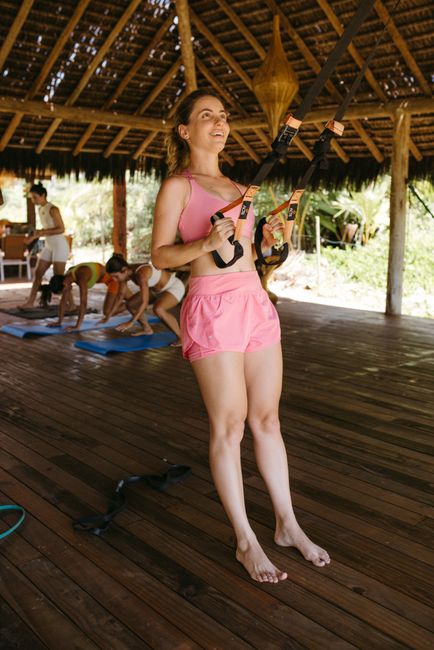
Ready to put this into practice? Start with these three "Longevity Tests" this week:
- The Sit-to-Stand Test: Can you sit down on the floor and get back up without using your hands? This is a famous clinical marker of musculoskeletal health.
- The 30-Second Hang: Can you hang from a pull-up bar for 30 seconds? Grip strength and shoulder distraction are vital for upper body health.
- The Balanced Hinge: Can you perform a single-leg hinge (touching your toes while one leg is extended behind you) without losing your balance?
Conclusion: Training for the Centenarian Decathlon
Mastering functional fitness training is about preparing for what some experts call the "Centenarian Decathlon." This is the list of ten physical tasks you want to be able to do when you are 100 years old. Whether it is lifting a suitcase into an overhead bin or walking a mile through a park, these abilities are earned through the movement patterns we practiced today.
By shifting your focus from how your muscles look to how your body moves, you are investing in a future of independence and ease. Start small, focus on the primal patterns, and remember: the goal of fitness isn't just to add years to your life, but to add life to your years. If you found this guide helpful, consider exploring our related tutorials on Advanced Mobility Drills and Nutrition for Metabolic Resilience.